

Ontario School System — Kindergarten to Grade 12 (2026–27), including the important recent changes.
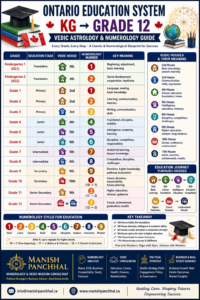
| Level | Grades | Main Focus | Numerology-style number |
|---|---|---|---|
| Early Years | Kindergarten Year 1 & 2 | Foundation, play, social/emotional development | 2 |
| Primary | Grades 1–3 | Reading, writing, mathematics, basic skills | 1–3 |
| Junior | Grades 4–6 | Knowledge, independence, core academics | 4–6 |
| Intermediate | Grades 7–8 | Advanced academics, preparation for secondary | 7–8 |
| Secondary | Grades 9–10 | Core high-school education & pathway exploration | 9–10 |
| Senior Secondary | Grades 11–12 | University, college, apprenticeship, workplace pathways | 11–12 |
🎓 Grade 9 → Grade 12 is particularly important
Grade 9
- Ontario’s current Grade 9 program is de-streamed, with course types including de-streamed, academic and open depending on the subject.
- Students begin building their secondary-school pathway.
Grade 10
- Students continue pathway exploration.
- Major 2026–27 update: students who entered Grade 9 in 2025–26 or later must meet the new Financial Literacy Graduation Requirement.
- It is completed through Grade 10 Career Studies.
- Students need 70% or higher on the financial-literacy requirement. Ontario
Grade 11
- Greater specialization.
- Courses increasingly relate to the student’s intended post-secondary destination.
Grade 12
- Final preparation for university, college, apprenticeship/training or workplace.
- Ontario provides destination-related courses including university, college, workplace and open courses. Ontario
🎓 Current OSSD requirement
For students entering Grade 9 in 2024–25 or later, the Ontario Secondary School Diploma requires:
30 credits
- 17 compulsory
- 13 optional
- Provincial literacy requirement
- Financial literacy graduation requirement
- At least 2 online learning credits
- 40 hours of community involvement
The financial-literacy requirement applies to students entering Grade 9 in 2025–26 and later, beginning with the 2026–27 school year. Ontario
🔢 If you want to connect this to your Numerology model
I would organize the student journey as:
KG–2 → Foundation
Grades 1–3 → Basic Learning
Grades 4–6 → Development
Grades 7–8 → Transition
Grades 9–10 → Direction & Financial Awareness
Grades 11–12 → Career / Post-secondary Destination
And for your Vedic + Numerology framework, we can separately map:
Student → 5th house → Higher Education → 9th house → Foreign Education → 12th house → Return/Home → 4th house → Career → 10th house.
That would make a useful “Ontario Students KG–12 + Vedic/Numerology” poster for your consulting work. Ontario
Yes. If you want a simple Grade/%-wise guidance model after Grade 12, I would use this:
🎓 After Grade 12 — Ontario Student Guidance
| Grade / % | Suggested Direction |
|---|---|
| 90–100% | University — highly competitive programs; scholarships |
| 80–89% | University — most competitive programs |
| 70–79% | University / College — good range; compare program requirements |
| 60–69% | College / University — program-specific options |
| 50–59% | College, skilled trades, certificates; upgrade if needed |
| Below 50% | Academic upgrading, alternative pathways, foundational programs |
After College / University
College → Diploma → Advanced Diploma → Degree / Graduate Certificate → Employment
University → Bachelor’s → Master’s → PhD / Professional Program → Employment
Simple Numerology-style grouping
- 1–3: Foundation / basic skills
- 4–6: Development / practical learning
- 7–8: Specialization / preparation
- 9–10: Higher education / career direction
- 11–12: Advanced secondary / post-secondary transition
- 13+: College / University / professional specialization